

FUNCTIONAL,
NOT JUST GREEN
SHELLIE® is a functional material made from discarded eggshells. Our goal is to deliver antibacterial and anti-rust functions — usually provided by synthetic chemicals — with a natural material.
A functional calcium powder made from calcined eggshell
Eggshell is mostly calcium carbonate. When it is heated (calcined), it becomes calcium oxide. When calcium oxide reacts with water, it becomes calcium hydroxide. SHELLIE is a functional powder whose main component is this eggshell-derived calcium hydroxide.
Calcium hydroxide is strongly alkaline in water (a saturated solution has a pH of about 12.4 at 25 °C). This alkalinity, together with the chemistry of calcium, is the basis of functions such as antibacterial and deodorising effects.
With our own surface treatment and particle design, Nexresin makes this powder spread evenly in plastics, coatings and fibres, so it keeps its functions inside the final product.
Source for the pH value: National Institute of Standards and Technology (NIST), Certificate of Standard Reference Material 2193b
The strength of SHELLIE
Our own particle processing technology gives SHELLIE physical properties that resist cracking, even at 70–80% eggshell loading.
We treat the surface of each eggshell-based particle so it blends into plastics and paints.
Our own particle shape and size improve dispersion in plastics, coatings and fibres.
It releases CO₂ —
and takes it back in.
When lime is heated, it releases carbon dioxide. While it is being used, it takes carbon dioxide back from the air and slowly returns to calcium carbonate. This "lime cycle" has been known for a long time, and it also applies to SHELLIE, which is made from eggshells.
- OutDuring calcination, calcium carbonate breaks down and releases carbon dioxide.
- InCalcium hydroxide reacts with moisture and carbon dioxide in the air and slowly turns back into calcium carbonate. Lime plaster hardens over the years by the same reaction.
How much is absorbed, and how fast, depends on how SHELLIE is used — for example, mixed into plastic or applied as a coating. It does not take back all of the carbon dioxide released during calcination.
In the end, it helps the soil and water.
Plastic products made with SHELLIE are recycled and used again and again. When the plastic is finally melted and separated, the SHELLIE Powder (calcined eggshell) left over may be used to improve soil and water.
Soil improvement
It neutralises acidic soil. In field tests, eggshells raised soil pH in the same way as a common liming material (dolomitic lime).
Sebonela et al., Agronomy, 14 (2024)
Water treatment
Calcined eggshell is being studied as a material to remove phosphorus from wastewater. Calcium hydroxide made from eggshells has also been used in research to remove fluoride from water.
Fritzen & Benetti, Water Science & Technology (2021) / Chen et al., RSC Advances (2022)
Fertiliser
Slaked lime (calcium hydroxide) is listed as a lime fertiliser under Japan's fertiliser law, with official standards, and has long been used to prepare soil.
Ministry of Agriculture, Forestry and Fisheries of Japan, official standards for ordinary fertilisers (lime fertilisers)
These items introduce research and rules about eggshell, calcined eggshell and calcium hydroxide.
Lime has protected our homes
for thousands of years.
Calcium hydroxide (slaked lime) has been used around the world to coat walls. SHELLIE SHIELD brings this wisdom of lime into modern coatings, using a material made from eggshells.

Shikkui plaster
The white walls of Japanese castles and storehouses are made with shikkui, whose main ingredient is slaked lime (calcium hydroxide). It slowly hardens by taking in carbon dioxide from the air.
Tochigi Prefectural Industrial Technology Center

White houses of the Aegean
The white houses of the Cyclades are whitewashed with lime. Lime works as a disinfectant to keep them clean, and the white walls keep rooms cooler in summer.
Greek News Agenda, "Cycladic architecture"
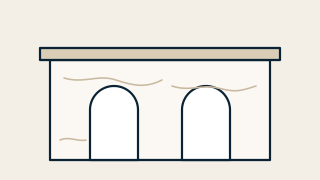
Marmorino
A traditional wall finish made from marble dust and lime. It goes back to ancient Rome, can be seen in the villas of Pompeii, and was described by the architect Vitruvius in the 1st century BC.
Wikipedia, "Marmorino"
What SHELLIE does
Antibacterial
Its alkalinity creates a surface where bacteria find it hard to grow. Confirmed by third-party tests with SHELLIE mixed into plastic.
Anti-rust
An alkaline environment helps keep a protective film on iron. Used in coatings, it helps prevent rust.
Deodorising
Works on acidic substances that cause sweat and everyday odours.
High loading
Up to 70–80% in plastics, reducing the amount of fossil-based resin.
Antibacterial and antiviral performance confirmed by a third-party lab
We tested PP injection-moulded plates containing 10% SHELLIE Powder against two bacteria and influenza A virus.
JIS Z 2801:2010
JIS Z 2801:2010
virus (H3N2)Antiviral activity
ISO 21702:2019
- The activity value is the difference, on a log scale, between the number of bacteria or viruses on the test piece and on an untreated control. 2.0 means a 99% reduction; 3.0 means 99.9%.
- Test piece: PP injection-moulded plate with 10% SHELLIE Powder. A value of 2.0 or more counts as "effective" (for antiviral activity, the SIAA criterion).
- Testing lab: Daiwa Chemical Industries Co., Ltd., R&D Division (antibacterial: July 2025; antiviral: August 2026).
- A PP plate without SHELLIE gave 1.0 (E. coli) and 0.7 (S. aureus), below the criterion.
- These results do not guarantee the performance of every finished product.
Let's make products with SHELLIE, together.
We welcome talks about joint development.